

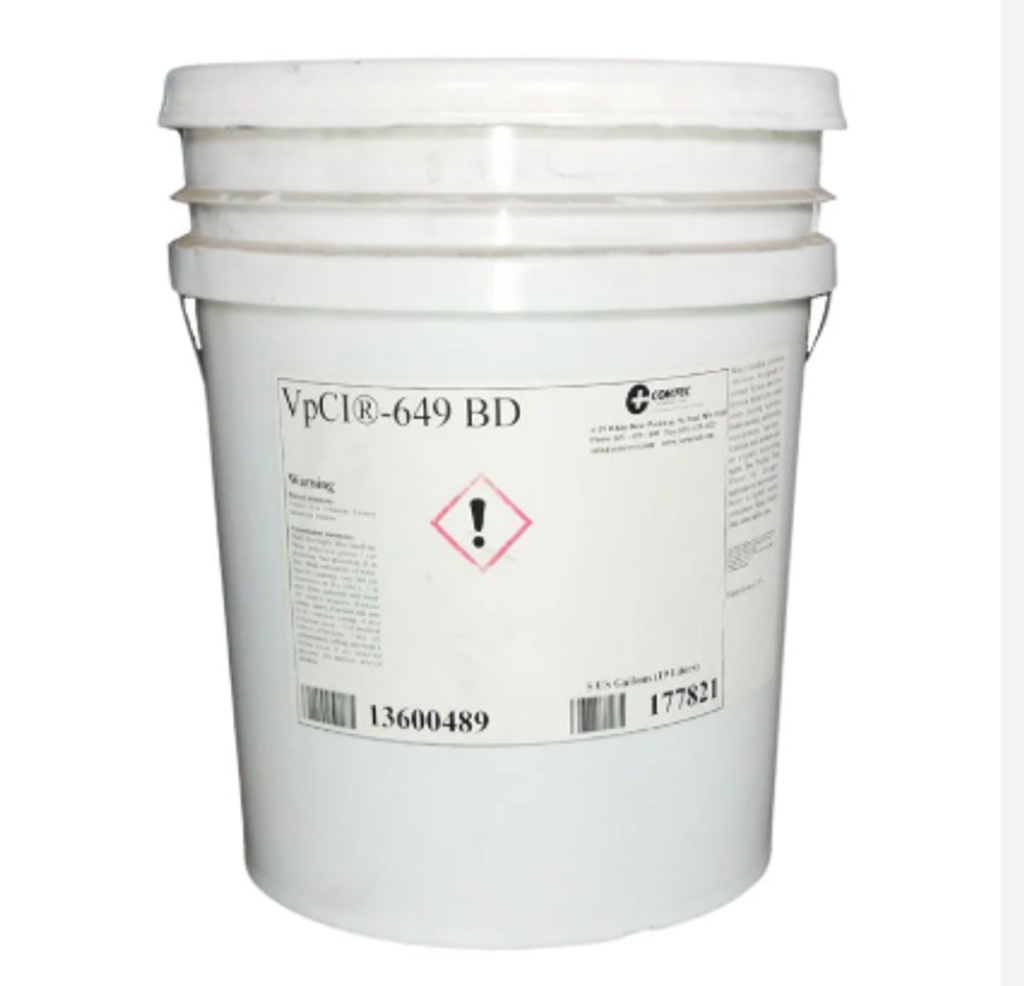
Cortec VpCI®-649 BD Winterized RTU
- Regular price
- RM 0.00
- Sale price
- RM 0.00
- Regular price
-
RM 0.00


Share
Product Description
VpCI®-649 BD Winterized RTU is a pre-diluted, organic-dispersion protectant ready for any closed loop system. Using Cortec®’s unique Vapor phase Corrosion Inhibitors (VpCI®) and fortified against the elements with propylene glycol, VpCI®-649 BD Winterized RTU protects cooling and other closed systems from freezing and corrosion.
For filling and flushing applications, VpCI®-649 BD Winterized RTU can be retained and reused without sacrificing corrosion protection or product performance.
Features
- Protects steel, copper, galvanized steel, and aluminum from corrosive elements in closed loop systems
- Contains an acrylic polymer to prevent scaling
- Effective in cooling systems, cooling layups, hot engine testing, hydrostatic testing of pressurized vessels and pipelines, and any other closed loop environment using water and/or glycol
- Contains organic dispersing agent
- Ready to use, with no onsite dilution necessary
Typical Properties*
| Appearance | Clear, colorless to slightly hazy yellow liquid |
| Density (ASTM D1475) | 8.4–9.2 lbs/gal (1–1.1 kg/L) |
| Freeze Point | 31°F (-35°C) |
| pH | 8–8.8 |
* Typical values represent average values and are intended as guides only, not as lot specifications.
Packaging & Storage
VpCI®-649 BD Winterized RTU is available in 5 gallon (19 L) pails, 55 gallon (208 L) drums, and 275 gallon (1,045 L) totes, as well as in bulk.
To ensure best product performance, store in original packaging, indoors, and out of direct sunlight at 40–100° F (4–38° C).
Shelf life: 2 years
Application
Prior to application, ensure the system is entirely free of contamination, such as mill scale, oil, rust, or grease. Incidental amounts of water will not interfere with VpCI®-649 BD Winterized RTU. Once ready, fill entire system with VpCI®-649 BD Winterized RTU. Dilution is not required or recommended. For use in operating systems, the recommended maximum temperature is 180°F (82°C). For storage or layup, it provides freeze protection down to a temperature of -31°F (-35°C).
For concentration monitoring, test by titration, refractometry, pH, or using a molybdate tracer.